Endpoints
An endpoint makes something inside a Sandbox reachable from outside it. Endpoints are tunnels: the Buddy agent (bdy) running in the Sandbox holds an encrypted connection to Buddy, and Buddy publishes it on an address it assigns. Nothing is exposed directly, and there are no ports to open.
Every new Sandbox comes with one endpoint already configured - SSH, so you can connect to the machine. See Terminal and SSH. Everything else you want reachable - a web application, an API, a database - needs an endpoint of its own.
bdy tunnel, this is the same mechanism attached to a Sandbox.
Types
| Type | Use it for |
|---|---|
| HTTP | Web applications and APIs, with authentication, headers, and compression |
| TCP | Anything speaking a raw protocol - databases, message brokers |
| TLS | Encrypted connections with your own certificate |
In the UI
Endpoints are defined in the Sandbox settings. Click + to add one and decide five things:
| Field | What it is |
|---|---|
| Name | Name of the endpoint |
| Local endpoint | The port or address inside the Sandbox that traffic is forwarded to, for example 80 or localhost:8080 |
| Type | HTTP, TCP, or TLS |
| Authorization | Who is allowed through - an IP whitelist on any endpoint, plus Basic auth or Buddy auth on HTTP ones. See Security |
| Region | Where the endpoint is published - EU, US, or AS. Defaults to auto-detect |
Type and authorization share one dropdown next to Local endpoint.
Image loading...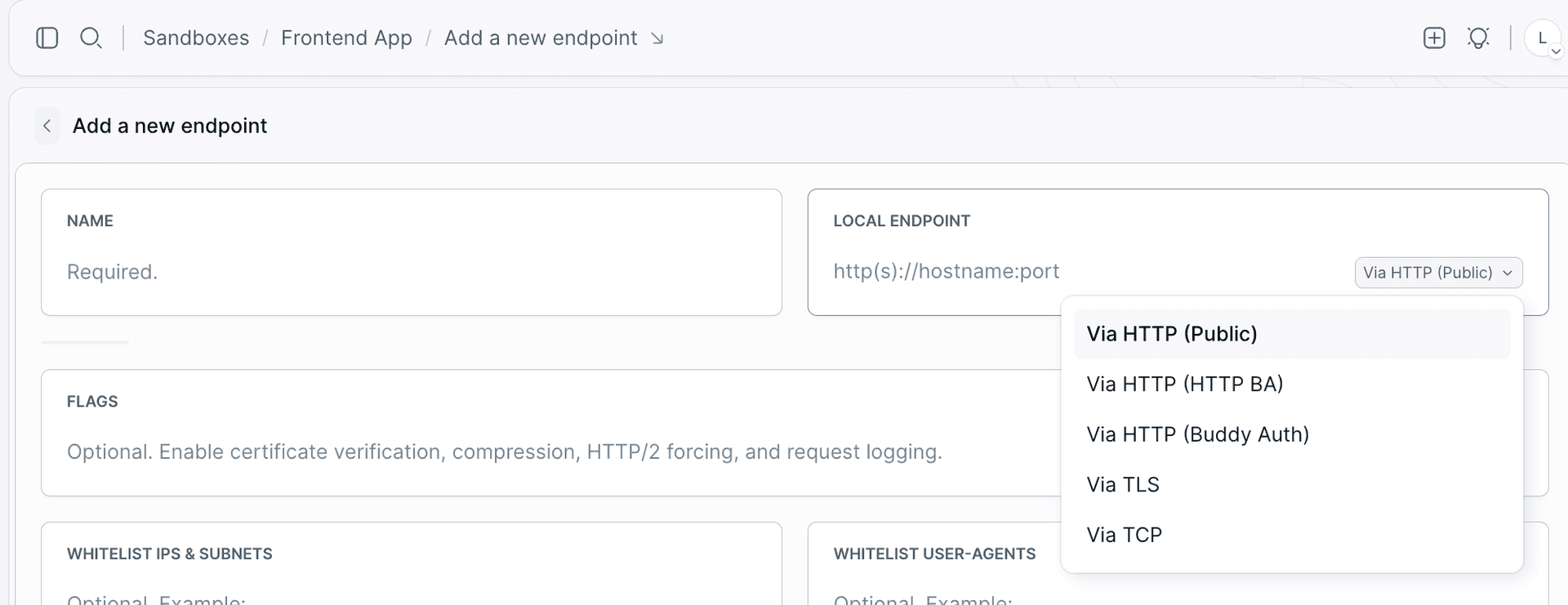
Once saved, the endpoint shows up in the Tunnels section with the address Buddy assigned - published from the EU, US, or AS region, which you can read off the eu-1 / us-1 part of the address. The section also lists the local port, the protection in place (None, HTTP BA, HTTP Buddy), and whether the endpoint is online. A recreated Sandbox can receive a new address. See Custom domains. Removing an endpoint immediately cuts off access through it.
Image loading...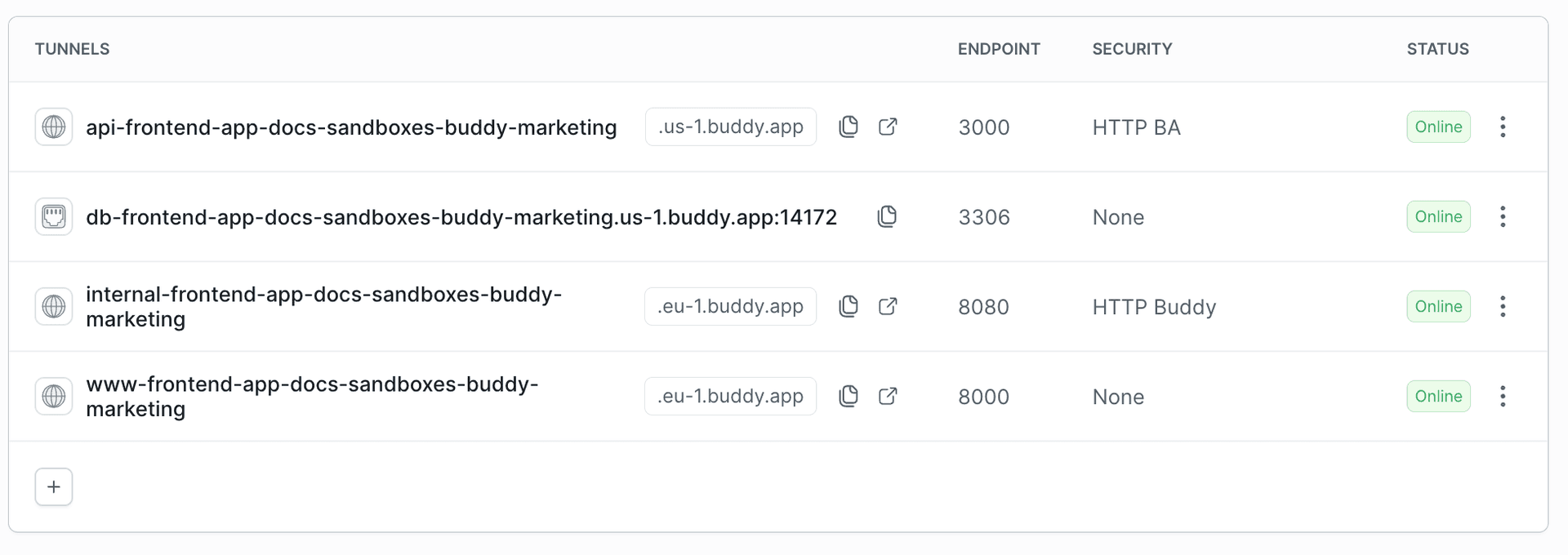
Security
Security applies to every endpoint, whatever its type:
| Setting | What it does |
|---|---|
| Whitelist IPs & subnets | Lets through only the listed addresses or CIDR ranges |
| Timeout | Connection timeout in seconds |
| Authentication | Basic auth or Buddy auth, HTTP endpoints only |
Authentication comes in two forms:
- Basic auth - a username and password prompt in front of the application.
- Buddy auth - only signed-in Buddy users get through. Allows your application to see who the visitors are. Their name, email, owner/admin flags, and groups - with no login flow of its own. See Identity.
HTTP endpoint security adds controls that only make sense for HTTP:
| Setting | What it does |
|---|---|
| Whitelist user-agents | Lets through only matching user-agents, given as text or a regular expression |
| Rewrite Host header | Sends a custom Host header to the application |
| Request header | Adds a header to every incoming request |
| Response header | Adds a header to every outgoing response |
| Circuit breaker | Failure-rate threshold, 0-100, at which the endpoint stops forwarding to a failing backend |
HTTP settings
Compression, HTTP/2, upstream certificate verification, and request logging are configurable per endpoint. Request logging is the fastest way to check whether traffic reaches the Sandbox at all - see Logs.
An HTTP endpoint can also serve files straight from a directory on the Sandbox disk, with no web server running at all.
TLS settings
For TLS endpoints you can supply your own certificate, private key, and CA certificate, and choose where TLS terminates - at the region, at the agent, or at the target.
From the CLI
bashbdy sb ep add my-sandbox -e 3000 -n www # HTTP on port 3000 bdy sb ep add my-sandbox -e 3306 -t TCP -n db # raw TCP bdy sb ep add my-sandbox -e 3000 -n www -r us # publish from the US region bdy sb ep add my-sandbox -e 3000 --whitelist 10.0.0.0/8 -a admin:secret bdy sb ep add my-sandbox -e 3000 --buddy # Buddy auth bdy sb ep list my-sandbox$$$$$$
In YAML
Endpoints support a full form and a shorthand. The shorthand is <name>: <endpoint>:
yamlendpoints: - name: www endpoint: localhost:8080 type: HTTP region: EU whitelist: - 10.0.0.0/8 timeout: 60 http: compression: true http2: true auth_type: BASIC auth: username: admin password: '!encrypted …' - metrics: 9090
Full key reference: Sandbox YAML.
Endpoints as pipeline targets
A Sandbox endpoint can be used as a target in pipeline actions, which is how a pipeline deploys files into a Sandbox or runs remote commands against it. See Sandboxes in pipelines and Targets.
If endpoints stop working
Endpoints depend on the agent running inside the Sandbox. If it is stopped or removed, every endpoint goes offline until the agent is restored - see Troubleshooting.
Last modified on Oct 7, 2026