TypeSafe and Jev now in Buddy
Buddy now integrates with TypeSafe, and with it comes a new pipeline action: Jev. Connect your API key once and your pipeline can ask a question about the run and get back one typed answer with a confidence value. Is this test failure flaky? How risky is this update? Does a human need to see this release? The answer is stored in a variable, so the next action branches on it with ordinary trigger conditions.
Jev is not another coding agent. Claude Code, Codex CLI and Cursor can inspect repositories, run commands, and change files. Jev evaluates the context provided to it and returns one of the predefined answers.
Step 1: connect TypeSafe
Open the Integrations tab, click New integration, and pick TypeSafe. All it needs is an API key: click Get API key under the field, create a key in TypeSafe, paste it in, give the integration a name and ID, and save.
Image loading...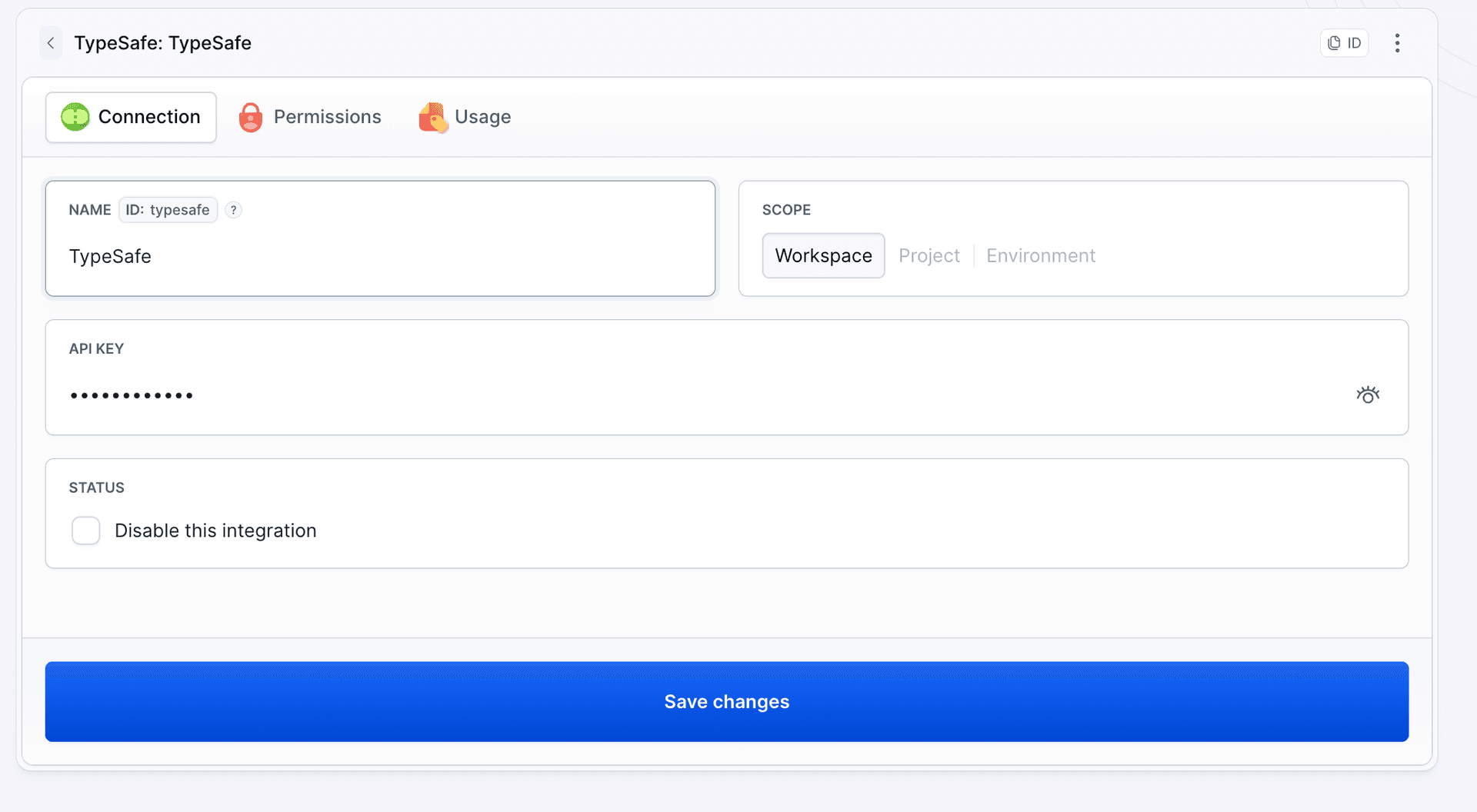
TypeSafe keys belong to the organization, not to the person who created them. If that person leaves, the key keeps working and so do the pipelines.
Step 2: ask one question
A Jev action has three parts: the state it should look at, the question, and the type of the answer. The state is a list of inline text with variables expanded at runtime, or files from the pipeline filesystem: a policy file from the repository, a diff, a log saved by a previous action. The question type determines the output: SCORE returns a position on a defined scale. CHOICE returns one of up to 255 options. BOOLEAN returns yes or no.
Image loading...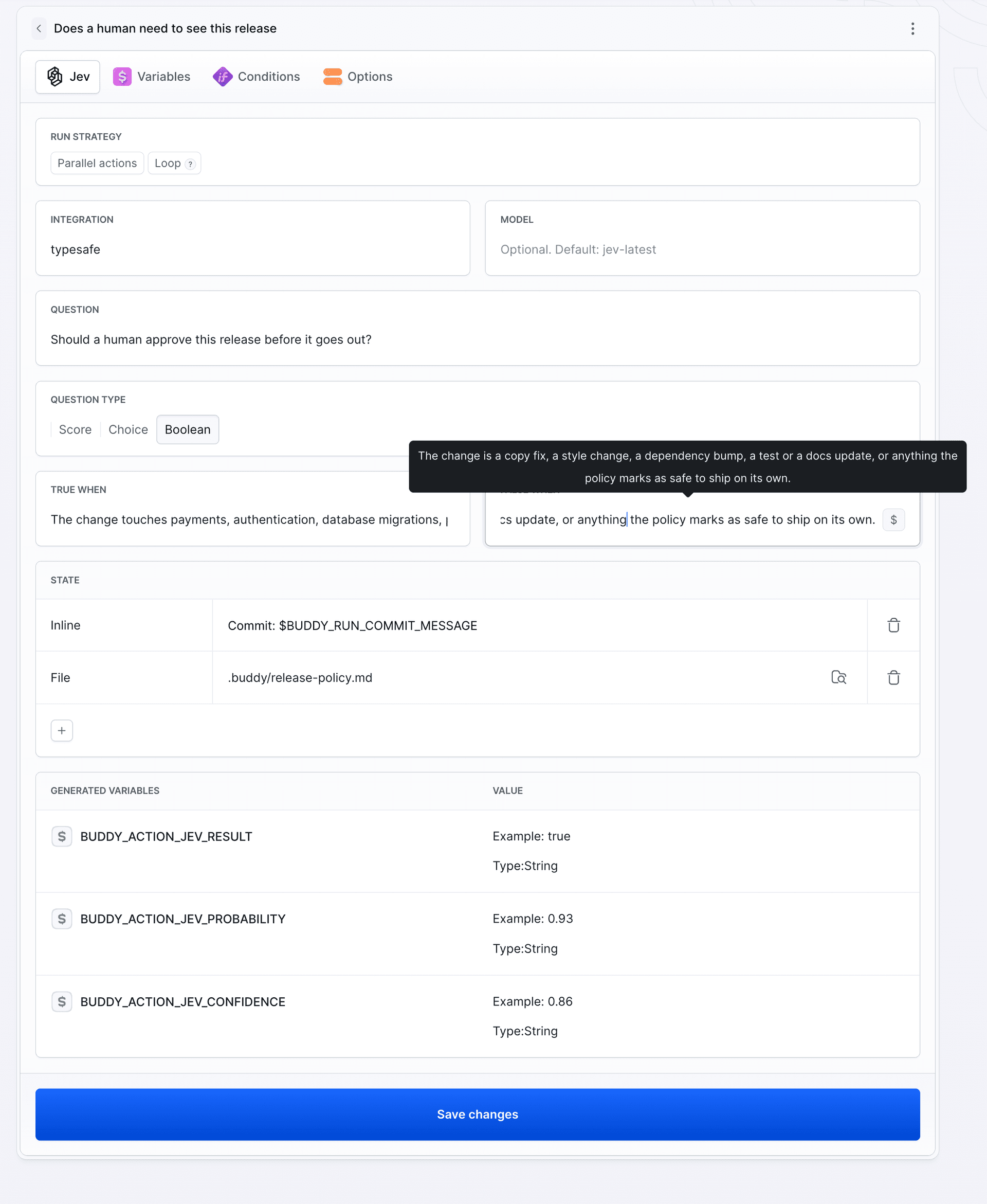
Jev writes the answer to BUDDY_ACTION_JEV_RESULT and its confidence to BUDDY_ACTION_JEV_CONFIDENCE. Score questions also get BUDDY_ACTION_JEV_SCORE, and every criterion gets its own BUDDY_ACTION_JEV_PROBABILITY_<KEY>. Later actions use them like any other variable.
Example: a release gate
Every push to main deploys unless Jev returns a result that requires manual review. Then the pipeline pings Slack and waits for approval:
yaml- pipeline: release-gate
  refs:
  - refs/heads/main
  events:
  - type: PUSH
  actions:
  - action: Does a human need to see this release
    type: JEV
    integration: typesafe
    question: Should a human approve this release before it goes out?
    question_type: BOOLEAN
    state:
    - "Commit: $BUDDY_RUN_COMMIT_MESSAGE"
    - file: .buddy/release-policy.md
    true_when: "The change touches payments, authentication, database migrations, pricing or anything the policy marks as needing a review before release."
    false_when: "The change is a copy fix, a style change, a dependency bump, a test or a docs update, or anything the policy marks as safe to ship on its own."
  - action: Ping releases
    type: SLACK
    integration: slack
    channel: releases
    content: "Jev wants a human on this one (confidence $BUDDY_ACTION_JEV_CONFIDENCE): $BUDDY_RUN_COMMIT_MESSAGE. Approve in Buddy: $BUDDY_RUN_URL"
    trigger_conditions:
    - trigger_condition: VAR_IS
      trigger_variable_key: BUDDY_ACTION_JEV_RESULT
      trigger_variable_value: "true"
  - action: Approve the release
    type: WAIT_FOR_APPLY
    description: "Jev flagged this release for review: $BUDDY_RUN_COMMIT_MESSAGE"
    trigger_conditions:
    - trigger_condition: VAR_IS
      trigger_variable_key: BUDDY_ACTION_JEV_RESULT
      trigger_variable_value: "true"
  - action: Deploy
    type: BUILD
    docker_image_name: buddy/localshell
    docker_image_tag: ubuntu_24.04
    commands: |-
      ./deploy.sh
Image loading...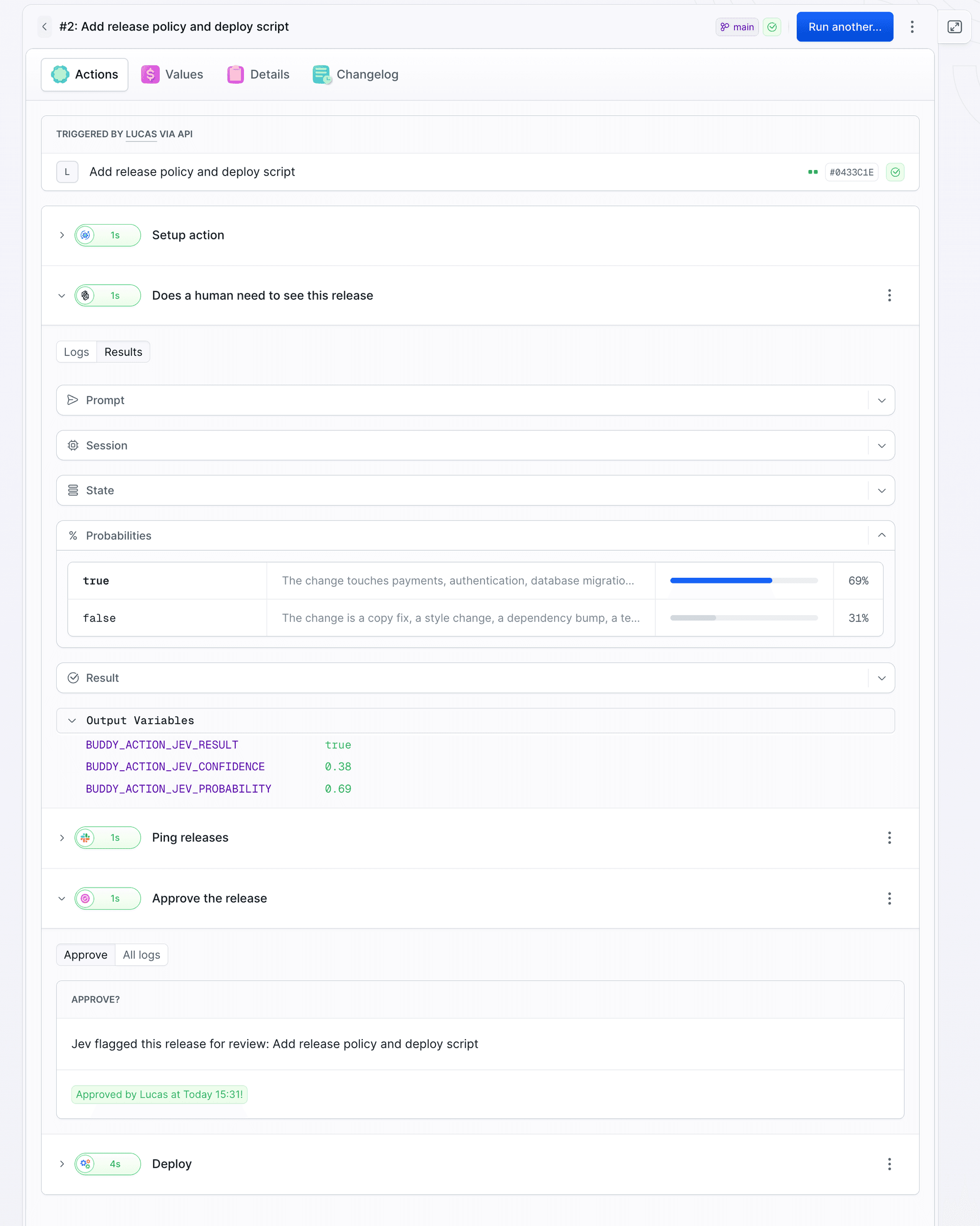
A copy fix ships on its own. A change in checkout stops at Approve the release with a message in Slack.
Image loading...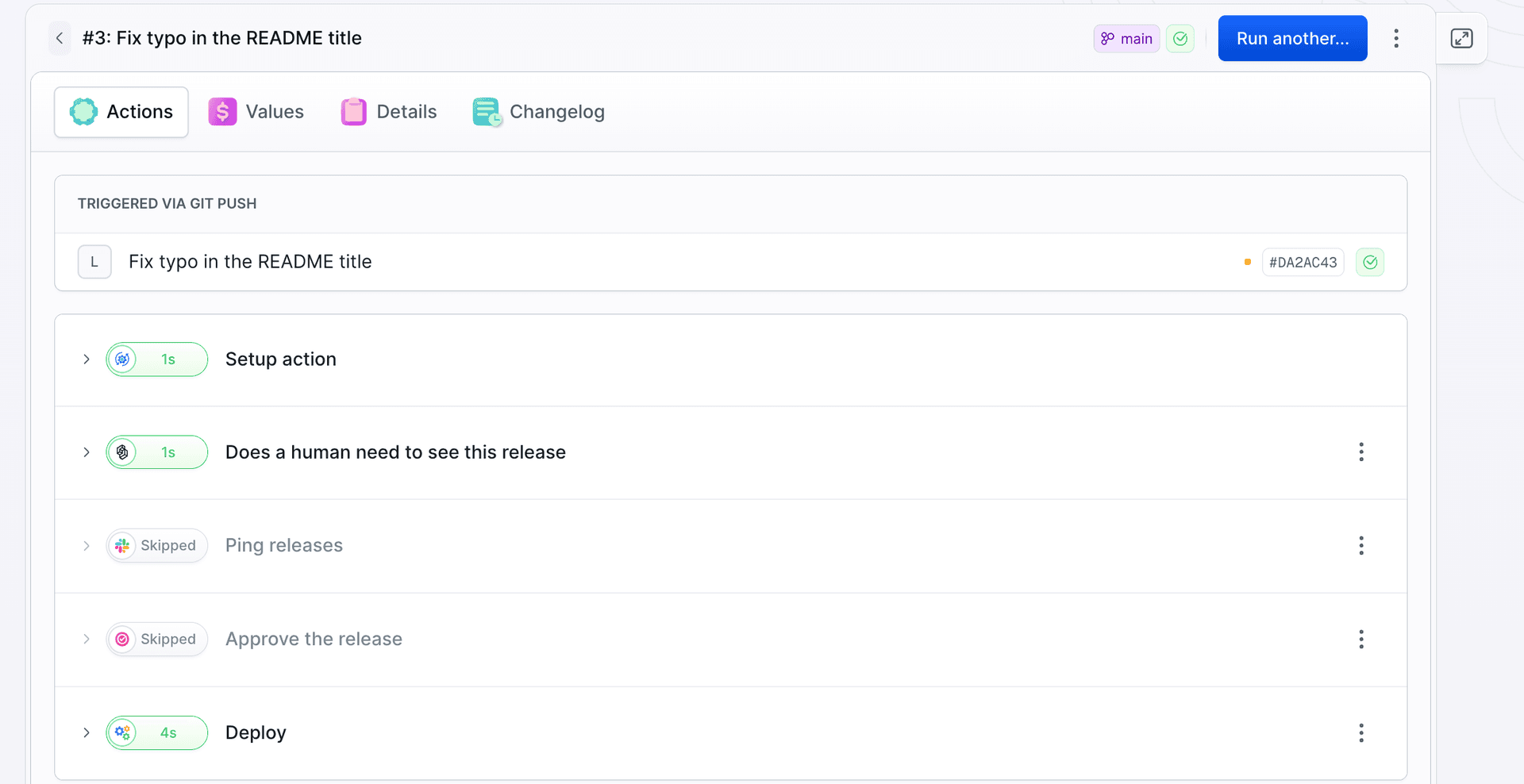
The policy consists of one file in the repository plus the true_when and false_when conditions. If the classification needs adjustment, you can update those conditions or the policy file.
Four pipelines that use it
We built four pipelines around Jev, each one on a small real project, with the runs and the mistakes we made along the way:
- Flaky test or bug? Let the pipeline decide - Jev classifies a failed test run as flaky, a real bug, an infrastructure problem or a case for a human, and the pipeline re-runs, notifies on-call or starts Claude Code to find the cause.
- Dependabot PRs: semver is not a risk model - Jev rates each Dependabot update from the release notes and your policy, and the pipeline merges the safe ones on its own.
- A preview sandbox only when shoppers will see the change - Jev reads the diff and answers whether a user will see the difference, so the preview link appears only when there is something to look at.
- Route coding tasks to the right agent - Jev picks Claude Haiku, Sonnet, Opus or Cursor for a task, asks a human when it is unsure and requires approval before anything touches payments.
Learn more
- TypeSafe integration - full setup, question types and output variables
- Jev action in YAML - every field
- Jev action in the API - POST parameters
- Conditional executions - every trigger condition you can put on the answer

Jarek Dylewski
Customer Support
A journalist and an SEO specialist trying to find himself in the unforgiving world of coders. Gamer, a non-fiction literature fan and obsessive carnivore. Jarek uses his talents to convert the programming lingo into a cohesive and approachable narration.